Evidence reviewed to Aug 2026
Neuromodulators — Botox and Its Rivals: What Botulinum Toxin Does, How Well It Works, and How Often Eyelids Droop
The short answer. Botulinum toxin type A reduces the appearance of moderate-to-severe frown lines between the brows, and over the short term it is relatively safe. HIGH · FDA label + RCTs It probably increases the risk of a temporarily drooping eyelid. MODERATE · Cochrane The effect is temporary — in the pivotal trials the median duration was about 120 days. Good evidence on repeated use over many years is thinner than the marketing suggests. Dosing, candidacy, and how any complication is handled are decisions for a licensed clinician, not for a web page.
Botulinum toxin is the most common cosmetic medical procedure in the United States: the American Society of Plastic Surgeons counted 9,883,711 neuromodulator treatments in 2024, up about 4% on the year before [6]. That volume, and the marketing around it, can make the treatment feel routine. It is a prescription drug with a boxed warning. This page lays out what the toxin does, which products exist, what the trials actually measured, and where the risks sit — every number tied to the source that produced it. Nobody at this publication received or performed any of this; it is informational only.
What is botulinum toxin, and how does it work?
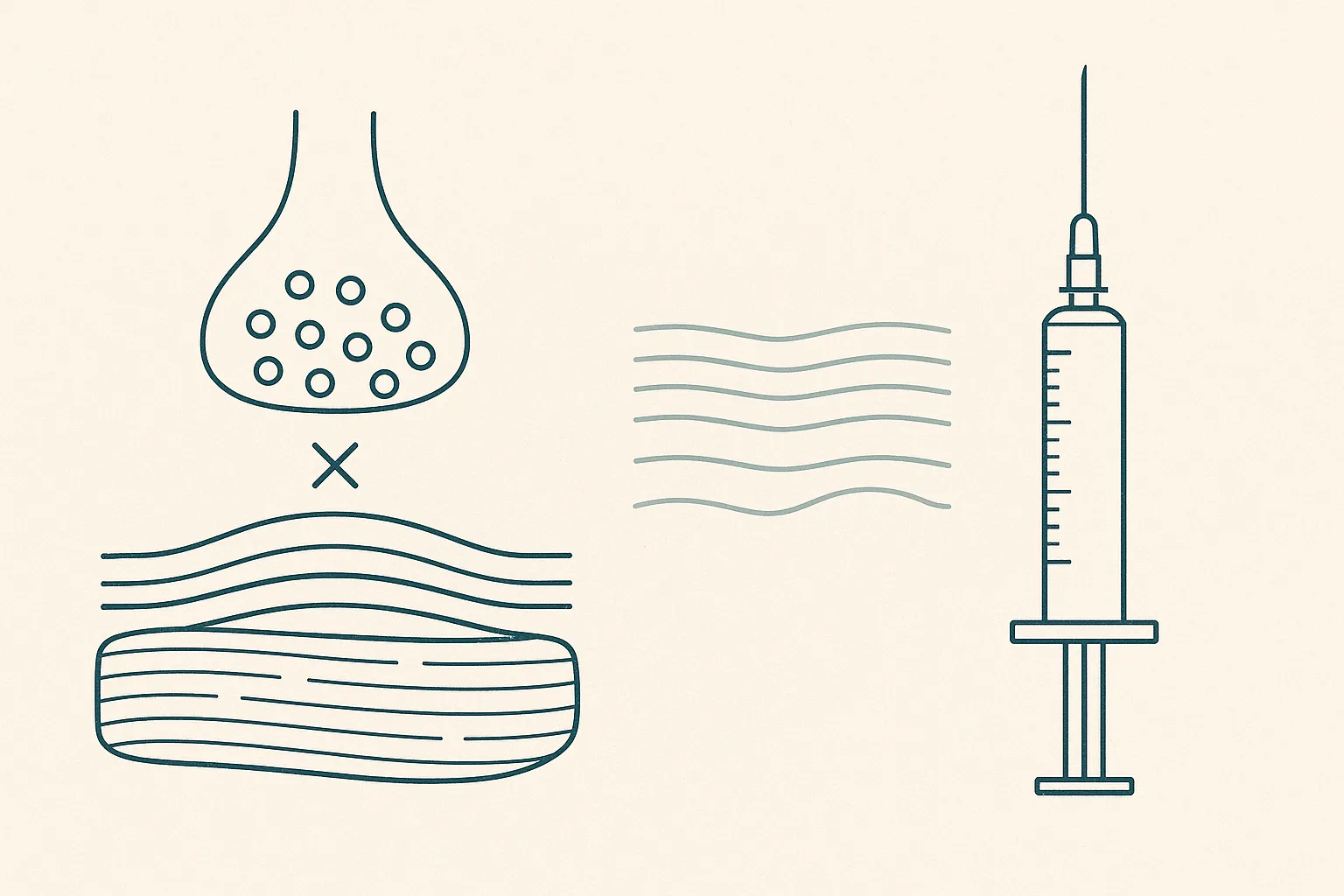
Botulinum toxin type A is a purified protein that produces local chemical denervation — in plain terms, it temporarily switches off the nerve-to-muscle signal in the small area where it is injected. It works by blocking the release of acetylcholine, the chemical messenger a nerve uses to tell a muscle to contract, at the neuromuscular junction. For frown lines, the target muscles are the corrugator and procerus — the muscles that pull the brows together. With those muscles weakened, the skin over them creases less, so the dynamic lines soften. This mechanism is described in the FDA prescribing information for BOTOX Cosmetic [1].
Two things follow from the mechanism. First, the effect is temporary: nerve terminals recover, the signal returns, and the muscle moves again — which is why maintenance treatments exist. Second, unlike a hyaluronic-acid filler, there is no antidote. A filler made of hyaluronic acid can be dissolved with an enzyme; botulinum toxin cannot be reversed on demand. If a result is not what you wanted, the option is to wait for it to wear off. That asymmetry is worth understanding before a first appointment.
Which products are we talking about? The six neuromodulators
“Neuromodulator” is the category, not a product. It is the word the profession and the industry statistics use for this class of injectable: the American Society of Plastic Surgeons counts neuromodulator treatments, not Botox treatments, and its 2024 figure of 9,883,711 covers every brand in the table below [6]. The distinction is practical, not pedantic. A consumer searching the category term is asking about all six products; a clinic advertising a single brand is answering about one of them. And a price quoted per unit of one neuromodulator is not comparable to a price per unit of another, because each manufacturer defines its own dosing unit — the point the paragraph after the table returns to.
“Botox” is a brand name that has become a generic verb, but it is one of six FDA-approved botulinum toxin type-A products marketed for cosmetic use in the United States. All six are the same class of molecule and all are prescription drugs regulated by the FDA — not devices, and not something a non-prescriber can lawfully obtain and use on their own. The aesthetic approval they share is for the temporary improvement of moderate-to-severe glabellar (frown) lines; several also carry approvals for forehead lines and crow's-feet [1].
| Product | Molecule | U.S. approval | Marketed duration | Evidence |
|---|---|---|---|---|
| Botox / Botox Cosmetic | onabotulinumtoxinA | Botox 1989; Cosmetic (glabellar) 2002 [1] | ~3–4 months | HIGH · FDA label |
| Dysport | abobotulinumtoxinA | FDA-approved type-A product | ~3–4 months | HIGH · FDA label |
| Xeomin | incobotulinumtoxinA | first FDA approval 2010 [10] | ~3–4 months | HIGH · FDA label |
| Jeuveau | prabotulinumtoxinA-xvfs | FDA-approved type-A product [3] | ~3–4 months | HIGH · RCT |
| Daxxify | daxibotulinumtoxinA-lanm | glabellar lines 2022 [9] | ~4–6 months (marketed) | MODERATE · maker's trials |
| Letybo | letibotulinumtoxinA | FDA-approved type-A product | ~3–4 months | HIGH · FDA label |
Where a specific U.S. approval year is not stated above, it is because this page cites only years we can attribute to the FDA record directly; the products without a year listed are all FDA-approved botulinum toxin type-A products, and the exact date is on each one's FDA label. What genuinely differs between them is mostly at the margins — protein formulation, diffusion characteristics, and dosing units that are not interchangeable between brands. Daxxify is the one product with a distinct duration claim. It uses a peptide stabilizer and is marketed for a longer effect, roughly 4–6 months rather than 3–4 [9]. That is a manufacturer-trial claim graded accordingly, not an independent head-to-head result; whether the extra weeks hold up in ordinary practice is exactly the kind of question a licensed clinician should answer for your face, not a brand's brochure.
One more thing the label controls is area. Crow’s-feet — the lateral canthal lines that fan out from the outer corner of the eye — are a separate indication from the glabellar lines the pivotal trials measured: a different muscle, a different injection pattern, and a different dose. Clinic pages are organised by the area a patient wants treated rather than by the indication the approval rests on, so a practice page describing treatment for crow’s feet will talk about the eye area and the expected result, where the FDA label talks about lateral canthal line severity. Reading one next to the other is a quick way to see which part of an offer comes from the trials and which part comes from the copywriting.
How well does it actually work, and for how long?
The pivotal trials for these products share a design: multicenter, randomized, double-blind, placebo-controlled, measuring the reduction in glabellar-line severity at 30 days after injection [1][3]. Against that endpoint, botulinum toxin type A performs consistently — this is why the “reduces” verb above earns a high-certainty grade.
Timing matters, and it is often mis-stated. Peak effect for onabotulinumtoxinA develops over 30 to 60 days — most of it in the first two weeks, but the full result is not immediate [2]. Duration is where marketing and evidence part ways. In the pivotal studies, the median duration of response for dynamic glabellar lines was 120 days — about four months [1]. Real-world duration is generally quoted at 3–4 months for Botox, Dysport, Xeomin, and Jeuveau [2]; Daxxify is marketed longer [9]. If a provider or an ad promises “a year of Botox,” that is not what the trials measured for a standard cosmetic dose.
On being “frozen”: an expressionless result is not an inherent property of the drug. It is a function of dose and injection placement, and it is a conversation to have in the consultation — some people want maximum softening, others want to keep movement. That is a clinician-and-patient decision, and it is out of scope here to prescribe a number.
The honest gap is long-term repeated use. The trials that establish efficacy are short — weeks to a few months. Robust evidence on what many years of repeated treatment does is thinner, which a Cochrane systematic review of botulinum toxin for facial lines reflects in its cautious framing [4]. That is not a claim of harm; it is a claim that the long-horizon data are limited. See What we don't know.
What are the risks, honestly ranked?
Risks belong on the same page as benefits. The table below runs from the common and minor to the rare and serious. Every row is drawn from FDA labeling or a cited investigation — not from anecdote.
| Frequency | What can happen | Source |
|---|---|---|
| Common | Injection-site reactions (redness, bruising, tenderness); headache | FDA BOTOX Cosmetic label [1] |
| Less common | Eyelid ptosis — a temporary drooping of the upper eyelid when the toxin affects a nearby muscle | FDA label [1]; Cochrane review [4] |
| Uncommon | Known hypersensitivity reactions; injection into an area of active infection is contraindicated | FDA label [1] |
| Rare / serious | Distant spread of toxin effect — the class boxed warning: symptoms of botulism (trouble swallowing, speaking, or breathing; generalized muscle weakness) that can appear hours to weeks after injection and can be life-threatening | FDA label, boxed warning [1] |
The most consumer-relevant of these is eyelid ptosis — a temporary droop of the upper eyelid that happens when the toxin affects the muscle that lifts the lid. It resolves as the drug wears off, but it can last weeks. This is why the verdict at the top says the treatment “probably increases” ptosis risk: it is a labeled adverse event [1], and a Cochrane systematic review of the evidence points the same direction [4].
The rare-but-serious end of the ladder — the boxed warning about distant spread — is the same picture that appeared in a very different context in 2024, when the toxin was counterfeit or mishandled. As of April 15, 2024, the U.S. Centers for Disease Control and Prevention had received reports of 19 people in 9 states with harmful reactions after injections of counterfeit botulinum toxin, or injections given by unlicensed or untrained people and/or in non-healthcare settings such as homes and spas. Nine were hospitalized, and four were treated with botulism antitoxin; there were no deaths. The reported symptoms — blurry or double vision, drooping eyelids, difficulty swallowing, slurred speech, difficulty breathing, generalized weakness — are consistent with the toxin spreading beyond the injection site [7]. Those cases are a strong argument for who injects and where, a subject taken up in the provider-vetting articles on this site.
If something feels wrong after an injection
Seek emergency care right away if, in the hours or days after botulinum toxin, you have trouble swallowing, trouble speaking, trouble breathing, blurred or double vision, or muscle weakness that spreads beyond the treated area. Per the FDA boxed warning, these can be signs that the toxin has spread, and they can be serious [1]. Contact your treating clinician, and go to an emergency room for breathing or swallowing difficulty. Adverse reactions and suspected counterfeit products can be reported to the FDA's MedWatch program [8]. This box is information, not a diagnosis; a licensed clinician manages any complication.
Who should not have it, and what does it cost?
The FDA labeling lists clear contraindications: botulinum toxin should not be injected into a site of active infection, and it is contraindicated in people with a known hypersensitivity to the product [1]. Beyond those, candidacy is an individual medical judgment — your health history, medications, and goals all belong in a consultation with a licensed clinician, who is the decision-maker on whether this treatment is appropriate for you at all.
On price: the American Society of Plastic Surgeons reports a national average physician fee of $435 for a botulinum toxin injection [5]. Read that number with care. It is a physician-fee average only — it excludes the product itself, the facility, and other costs — so it understates the all-in price a consumer actually pays, and local per-unit or per-area pricing runs higher. It is offered here as a published reference point, not as a quote and not as a reason to choose the cheapest option. A price that could not plausibly cover legitimate product plus a licensed injector is a signal worth taking seriously — the 2024 counterfeit cluster is the cautionary tale [7].
Questions to ask a licensed clinician
A good provider welcomes these; evasion is itself an answer. Print or screenshot this list and take it to the consultation.
- What is your license and credential, and who is the supervising or prescribing physician here?
- Which product will you use (Botox, Dysport, Xeomin, Jeuveau, Daxxify, Letybo), and may I see the sealed vial and its lot number?
- How many units, in which muscles, and what result are we aiming for — full softening or preserved movement?
- When will it peak, and how long do you expect it to last on me? (The trials' median was about 120 days [1].)
- It cannot be reversed like a hyaluronic-acid filler — so what happens if I do not like the result?
- What are the warning signs of a problem, and who do I call, day or night, if I have trouble swallowing or breathing?
- What is the itemized cost — per unit or per area — and what is included?
What we don't know
Reviewed to August 2026.
- Long-term repeated use. The efficacy trials are short. Rigorous data on what many years of repeated treatment does — to the muscles, the skin, or the result over time — remain limited, a gap reflected in the Cochrane review's cautious conclusions [4].
- Head-to-head superiority. Marketing implies meaningful differences between brands. Independent trials directly comparing products on the same patients are far fewer than the number of comparative claims made; Daxxify's longer-duration claim in particular rests largely on the manufacturer's own trials [9].
- “Preventative” use in your twenties. Whether starting early changes the long-term trajectory of facial lines is not well established. What is known is that stopping causes no permanent change — muscle activity simply returns as the drug wears off.
Not medical advice. This page is informational only and is not a substitute for a consultation with a licensed clinician. Candidacy, dosing, product choice, and the management of any complication are individual medical decisions and are out of scope here.
References
- FDA, BOTOX Cosmetic (onabotulinumtoxinA) for injection — prescribing information, including boxed warning, mechanism, adverse reactions, and contraindications. accessdata.fda.gov (2018 label PDF).
- “Treatment of glabellar lines with botulinum toxin: development, insights, and impact,” 2023. PubMed 37499082 (onset, duration, Daxxify peptide-stabilizer duration).
- Phase II randomized controlled trial of prabotulinumtoxinA for glabellar lines, 2024. PMC PMC11334208 (pivotal-trial design and 30-day endpoint).
- Camargo CP, et al. “Botulinum toxin type A for facial wrinkles,” Cochrane Database of Systematic Reviews 2021, CD011301.pub2. cochranelibrary.com (reduces glabellar lines at four weeks; probably increases eyelid-ptosis risk; limited long-term data).
- American Society of Plastic Surgeons, botulinum toxin cost (national average physician fee, $435). plasticsurgery.org.
- American Society of Plastic Surgeons, 2024 Plastic Surgery Statistics Report (neuromodulator treatments 9,883,711, +4% year over year). plasticsurgery.org.
- CDC, “CDC Investigating Harmful Reactions to Counterfeit Botox” (press release, April 16, 2024) — 19 people in 9 states as of April 15, 2024; 9 hospitalized, 4 given botulism antitoxin; no deaths. cdc.gov/media/releases/2024/s0416.
- FDA MedWatch — the FDA Safety Information and Adverse Event Reporting Program. fda.gov/safety/medwatch.
- FDA, DAXXIFY (daxibotulinumtoxinA-lanm) for injection — prescribing information (initial U.S. approval September 2022 for glabellar lines; 35-amino-acid peptide excipient; SAKURA Phase 3 duration data). accessdata.fda.gov (2022 label PDF).
- FDA, XEOMIN (incobotulinumtoxinA) for injection — prescribing information, Initial U.S. Approval 2010. accessdata.fda.gov (label PDF).
Update log · Aug 2026 — first published.