IPL Photofacials vs Laser Resurfacing: Two Different Tools, Two Different Risk Profiles
Evidence reviewed to Aug 2026
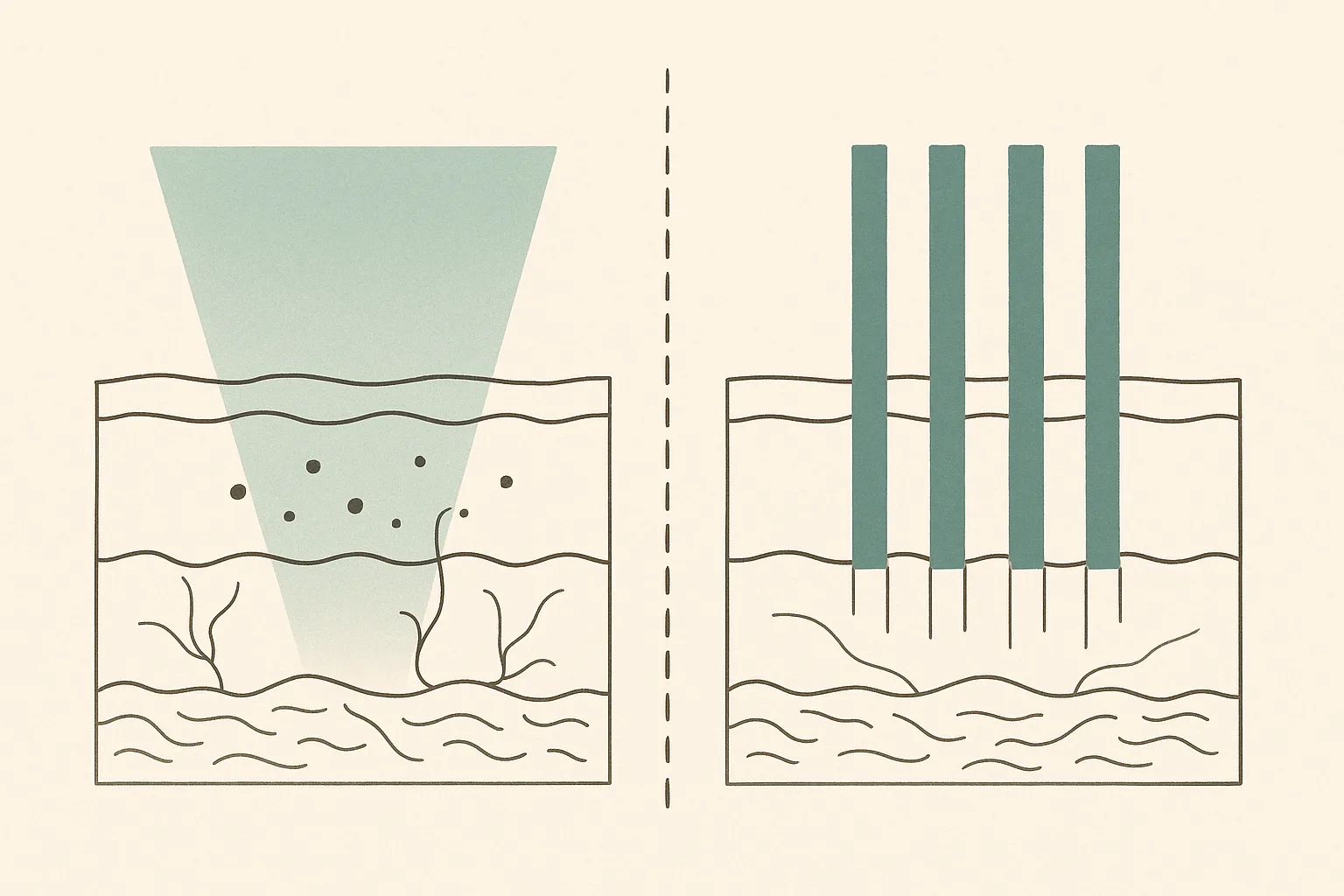
The verdict. IPL and laser resurfacing are not two versions of the same treatment. IPL (a photofacial) is a low-downtime tool that reduces facial redness and brown pigment, with only a modest measured effect on wrinkles. Ablative laser resurfacing is a different, heavier instrument: it can produce large wrinkle improvement, but at the cost of real recovery time and a meaningful risk of losing skin color (hypopigmentation). Neither is interchangeable with the other, and both concentrate their risk in the hands of whoever operates the device — which in most states is the practice of medicine. The right choice, and whether either is right at all, is a conversation for a licensed clinician.
This page explains what broadband light can and cannot fix, when ablative resurfacing is the actual tool, and the specific downtime and pigment risks each one carries. It is informational only and is not medical advice. Nobody associated with this publication has received or performed either procedure; every number below is attributed to the study or reference that measured it.
What is IPL, and is it even a laser?
No — and the difference is the whole point. IPL stands for intense pulsed light. Unlike a laser, which emits a single coherent wavelength, IPL is a non-coherent, polychromatic broadband flashlamp that emits a wide band of light, roughly 400 to 1200 nanometers, usually shaped by filters. That light is selectively absorbed by two targets in the skin — melanin (brown pigment) and hemoglobin (the red in blood vessels) — and converted to heat, a process called the photothermal effect. That is why IPL is used for the things those two targets represent: brown spots, broken vessels, and diffuse facial redness. It can also cause mild thermal remodeling of collagen as a secondary effect. High · review literature (Journal of Drugs in Dermatology, "Intense Pulsed Light: A Methodical Approach to Understanding Clinical Endpoints," 2021) [1].
Because the light is broad and relatively shallow, IPL is often marketed as a "lunchtime" or no-downtime treatment. That is largely true for what it does well — pigment and redness — and it is a large part of the appeal. It is also the reason its effect on wrinkles is limited: IPL is not removing or deeply remodeling tissue the way a resurfacing laser does.
What does IPL actually accomplish, by the numbers?
IPL has the best measured evidence for pigmentation and vascular concerns. It is documented as effective for facial redness (erythema), brown pigmentation, and rosacea (IJDVL systematic review of IPL in rosacea; multicenter photorejuvenation study) [3][4]. Its effect on wrinkles is real but modest, and it helps to see the actual figures rather than the marketing.
A multicenter clinical study of full-face IPL photorejuvenation in 93 patients (Fitzpatrick skin types I–III) reported that the Fitzpatrick Wrinkle and Elastosis Score — a validated scale a clinician uses to grade sun-related skin damage — improved by 1.39 units at 4 months and 1.32 units at 6 months, with improvement recorded in 82% of patients at 4 months and 75% at 6 months. Low · single-arm multicenter study (Journal of Drugs in Dermatology, 2004) [4]. A separate 2026 real-world study of long-term, regular IPL likewise reported significant improvement in facial erythema, pigmentation, and wrinkle indices (all p < 0.05), though it did not publish a single headline wrinkle number. Low · uncontrolled real-world study (Fan et al., Journal of Cosmetic Dermatology, 2026) [5]. That is a measurable, worthwhile change on a graded scale — and it is a fraction of what an ablative resurfacing laser is capable of on deep wrinkles. Read IPL as a tone-and-color tool that also nudges texture, not as a wrinkle eraser.
What are IPL's risks?
IPL is non-ablative — it does not remove the surface of the skin — so its risk profile is generally milder and its downtime shorter than ablative resurfacing. It is not, however, risk-free: a 2024 safety review argues that IPL's hazards are under-appreciated and that a safe outcome depends on careful candidate selection and correct device parameters, not on the machine alone. Moderate · safety review (Lin et al., 2024) [2]. The main issues are heat-related. Post-procedure redness is expected, and more aggressive device settings raise the risk of an adverse reaction. Burns and lasting pigment change are possible, and the risk is meaningfully higher in darker skin, because melanin is one of the light's primary targets — it absorbs strongly across roughly 400 to 755 nm — so in darker skin more energy is taken up by pigment in the surrounding skin rather than only in the intended target. High · mechanism review (Journal of Drugs in Dermatology clinical-endpoints review) [1].
That skin-type point is not a small caveat. The single most important safety variable in light- and laser-based treatment is matching the device and settings to the person's skin. The wrong settings on darker skin can cause burns and lasting pigment changes — hyperpigmentation (darkening) or hypopigmentation (lightening) — which is why an experienced operator who tests and adjusts matters more than any brand name on the machine.
What is laser resurfacing, and how is it different?
Laser resurfacing is a fundamentally more aggressive category. Ablative resurfacing works by removing the epidermis and superficial dermis — the outer and upper-middle layers of skin — to reduce the signs of photoaging. Two wavelengths dominate, and they trade off differently:
- Carbon dioxide (CO2) laser. It denatures collagen fibrils, causing immediate tissue contraction, and stimulates the skin to build new collagen over the following months. It is the most powerful of the resurfacing tools — and the one with the most downtime.
- Erbium:YAG (Er:YAG) laser. Its wavelength is absorbed by water far more strongly than the CO2 wavelength, so it vaporizes tissue with much less residual heat spreading into surrounding skin — a less coagulative effect than CO2. That generally means less swelling and redness and a faster recovery, with a somewhat gentler result and less skin-tightening. High · reference text (StatPearls) [6].
Both come in a fractional form, which is important for consumers to understand. Rather than treating the entire surface at once, a fractional laser treats microscopic columns of skin and leaves the tissue between them intact. Those untreated bridges heal the treated columns faster, which lowers downtime and risk compared with fully ablative treatment of the whole surface. High · reference texts (StatPearls, "Ablative Laser Resurfacing"; JCAD, "Update on Fractional Laser Technology") [6][9].
What does resurfacing accomplish, by the numbers?
This is where resurfacing separates itself from IPL. Improvement in rhytides (the clinical word for wrinkles) of up to about 90% has been reported with CO2 ablation. Moderate · reference review (StatPearls) [6]. That is a category of result IPL does not reach.
A head-to-head randomized controlled trial comparing fractional CO2 with fractional Er:YAG found that both produced considerable wrinkle improvement, with no serious adverse effects in the study — a useful data point that the gentler Er:YAG can deliver meaningful results, not only the most aggressive CO2 setting. Moderate · one RCT (Lasers in Medical Science, 2016) [7]. The trade-off, as always, is that bigger results come with bigger recovery and bigger risk.
What are the risks and downtime of resurfacing?
Ablative resurfacing asks for longer healing than non-ablative light like IPL, and it is the category that carries the serious, sometimes permanent complications — that is the price of the deeper result. A systematic review of 1,093 patients cataloged adverse events across ablative and non-ablative resurfacing and found that the most severe complications were uncommon overall (for example, hypertrophic scarring in about 0.046% of patients); what separates ablative from lighter tools is the nature of the complications it can cause, not their raw frequency. Moderate · systematic review (Dermatology and Therapy, 2021) [8]. The standard resurfacing reference catalogs the range of what can happen. High · reference text (StatPearls) [6].
| Frequency | What is reported | Source |
|---|---|---|
| Expected | Pain, swelling (edema), and redness after the procedure; StatPearls reports return to normal activity about 5 to 10 days after fractional CO2, with fully ablative treatment taking longer, while Er:YAG generally involves less swelling and redness and a faster recovery | StatPearls [6]; systematic review [8] |
| Common to less common | Prolonged or persistent erythema (redness lasting well beyond initial healing) | Systematic review [8] |
| Less common | Infection; post-inflammatory hyperpigmentation (temporary darkening), more likely in darker skin types | Systematic review [8]; StatPearls [6] |
| Uncommon but lasting | Hypopigmentation — potentially permanent loss of skin color; a recognized complication of ablative resurfacing, most associated with fully ablative CO2 and often delayed in onset | StatPearls [6] |
Hypopigmentation deserves emphasis because it is the risk that can be permanent and disfiguring. It is a recognized complication of ablative resurfacing — most associated with fully ablative CO2 treatment, and frequently delayed in onset — and StatPearls lists it among the adverse effects a clinician must weigh [6]. Unlike the transient redness that fades in days or weeks, lost pigment may not come back. This is the reason a careful clinician weighs skin type, device, and settings so heavily, and it is a central question to raise before agreeing to any ablative treatment.
IPL vs resurfacing, side by side
| IPL photofacial | Ablative laser resurfacing | |
|---|---|---|
| What it is | Broadband non-coherent light, ~400–1200 nm; not a laser | A single-wavelength laser (CO2 or Er:YAG) that removes skin layers |
| Best for | Brown pigment, facial redness, rosacea; modest texture | Deeper wrinkles and photoaging; larger textural change |
| Measured wrinkle effect | Fitzpatrick score improved ~1.3–1.4 units; 75–82% improved [4] | Up to ~90% rhytide improvement reported for CO2 [6] |
| Downtime | Minimal; largely non-ablative | ~5–10 days for fractional CO2, longer if fully ablative; less for Er:YAG [6] |
| Signature risk | Burns and pigment change, especially in darker skin [1][2] | Prolonged erythema, infection, PIH, and potentially permanent hypopigmentation [6][8] |
| Grade | Moderate · real-world + reviews | Moderate · RCT + reviews |
Who operates the device, and why it matters more than the brand
Energy-based devices concentrate risk in the operator. The same machine can produce a clean result or a burn depending on the settings, the skin type, and the judgment of the person holding it. Operating a laser or IPL device is considered the practice of medicine in most states, which generally requires a licensed prescriber and, in many states, a physician medical director and appropriate supervision of anyone else who performs the procedure. Scope-of-practice rules vary widely from state to state. High · legal/industry sources (Quarles Law med-spa compliance materials; American Med Spa Association) [10].
The practical consequence for a consumer: a device-marketing claim ("our new platform is painless and works on every skin type") is not a substitute for an experienced operator who assesses your skin, chooses the right tool and settings, and can recognize and manage a complication. The questions below are aimed at exactly that.
Ask these before anyone fires a light device at your face. A good provider welcomes every one of these; evasion is itself an answer.
- Is this IPL or an ablative laser — and given my goals, why this tool rather than the other?
- What is your training and experience with this specific device on skin like mine?
- What is my Fitzpatrick skin type, and how does that change the settings and my risk of burns or pigment change?
- What downtime should I plan for, and what will my skin look like at day 1, day 3, and week 2?
- What is the realistic result — and, honestly, what will this not fix?
- What are the signs of a complication, who do I call, and what is the plan if one happens?
What does it cost, and how common is it?
Light- and laser-based skin treatments are among the highest-volume aesthetic procedures in the United States: the American Society of Plastic Surgeons (ASPS) counted 3,112,056 skin treatments — a category that includes laser hair removal, IPL, laser vein treatment, and tattoo removal — in its 2024 Plastic Surgery Statistics Report. Moderate · ASPS statistics [11]. ASPS does not publish a single simple national fee that isolates IPL or ablative resurfacing on its own, and prices vary widely by device, the number of sessions, the area treated, and the market — so this page does not quote a figure it cannot source. Any price you are quoted should be understood as covering a course of treatment, not a fixed single number, and a price that seems far below the cost of a legitimate device operated by a qualified clinician is a signal worth questioning.
What we don't know
Stated plainly, and dated to August 2026:
- The graded IPL wrinkle figures here come from a single-arm multicenter study in Fitzpatrick I–III skin, not a randomized controlled trial; a 2026 real-world study points the same direction, but the size of IPL's texture effect across different devices and skin types is not precisely settled [4][5].
- There is no single firm rate for hypopigmentation after ablative resurfacing; reported frequencies vary with device, technique, and skin type, and the risk is concentrated in fully ablative CO2 treatment [6][8].
- Head-to-head data directly comparing IPL against ablative resurfacing for the same person and goal is limited; the two are usually studied separately, for different problems.
- Scope-of-practice law changes, so who may legally operate these devices in your state should be verified with your own state's medical or nursing board, not assumed from any general summary [10].
The bottom line
IPL and laser resurfacing solve different problems and carry different risks. If the concern is brown spots, redness, or rosacea, IPL is the lower-downtime tool with the better-matched evidence, and it will only nudge deep wrinkles. If the goal is a large improvement in deep wrinkles and photoaging, ablative resurfacing is the tool that can deliver it — and it asks for real recovery time and carries a genuine, sometimes permanent, risk of pigment loss. The variable that most determines whether either goes well is not the machine; it is the match between the device, the settings, your skin type, and the operator's judgment. That match is a medical decision, and this page exists to help you interrogate it — with a licensed clinician, before you book.
References
- Journal of Drugs in Dermatology. Intense Pulsed Light: A Methodical Approach to Understanding Clinical Endpoints. 2021 (broadband 400–1200 nm mechanism; melanin and hemoglobin chromophores; clinical endpoints).
- Lin M-Y, Wong T-W, Lin C-S. Revisiting Unaddressed Safety Concerns Regarding Intense Pulsed Light Treatment: Past and Present Perspectives. Photodermatology, Photoimmunology & Photomedicine. 2024. doi:10.1111/phpp.13005. PMID 39388538.
- Indian Journal of Dermatology, Venereology and Leprology. Efficacy and safety of intense pulsed light in rosacea: A systematic review. 2024.
- Photorejuvenation with intense pulsed light: results of a multi-center study. Journal of Drugs in Dermatology. 2004. PubMed 14964745 (Fitzpatrick W/ES improved 1.39 and 1.32 units, 82% and 75% of patients improved at 4 and 6 months).
- Fan B, Yu R. Comprehensive Facial Skin Rejuvenation With Long-Term Regular Intense Pulsed Light Therapy: A Real-World Study. Journal of Cosmetic Dermatology. 2026. doi:10.1111/jocd.70691. PMID 41582594.
- StatPearls. Ablative Laser Resurfacing (CO2 and Er:YAG mechanism, efficacy, and adverse effects). NBK557474.
- Lasers in Medical Science. Fractional CO2 versus fractional Er:YAG laser for facial rejuvenation: a randomized controlled trial. 2016. PMID 27885522.
- Outcomes and adverse effects of ablative vs nonablative lasers for skin resurfacing: a systematic review of 1,093 patients. Dermatology and Therapy. 2021 (adverse-event catalog; hypertrophic scarring in ~0.046% of patients). PubMed 33084193.
- Journal of Clinical and Aesthetic Dermatology. Aesthetic Update: Update on Fractional Laser Technology (fractional delivery and downtime).
- Quarles Law, "Med Spa Compliance Series: Scope of Practice and Supervising Physician Compliance"; American Med Spa Association scope-of-practice materials. americanmedspa.org.
- American Society of Plastic Surgeons. 2024 Plastic Surgery Statistics Report (skin-treatment procedure volume, including IPL and laser).
Not medical advice. This article is informational only and is not a substitute for a consultation with a licensed clinician. Whether IPL or laser resurfacing is appropriate for you, with which device and settings, and how any complication should be managed are individual medical judgments. See How We Source for how every claim on this page is sourced and graded.
Update log
- 2026-08-05 — First published. Evidence reviewed to August 2026 against IPL clinical-endpoint and erythema literature, the 2026 long-term IPL real-world study, the fractional CO2 vs Er:YAG RCT, the ablative vs non-ablative systematic review, StatPearls, and ASPS 2024 procedure volume.