Evidence reviewed to Aug 2026
RF Microneedling and PRP: Promising Evidence, a 2025 FDA Warning, and What "Not FDA-Approved" Really Means
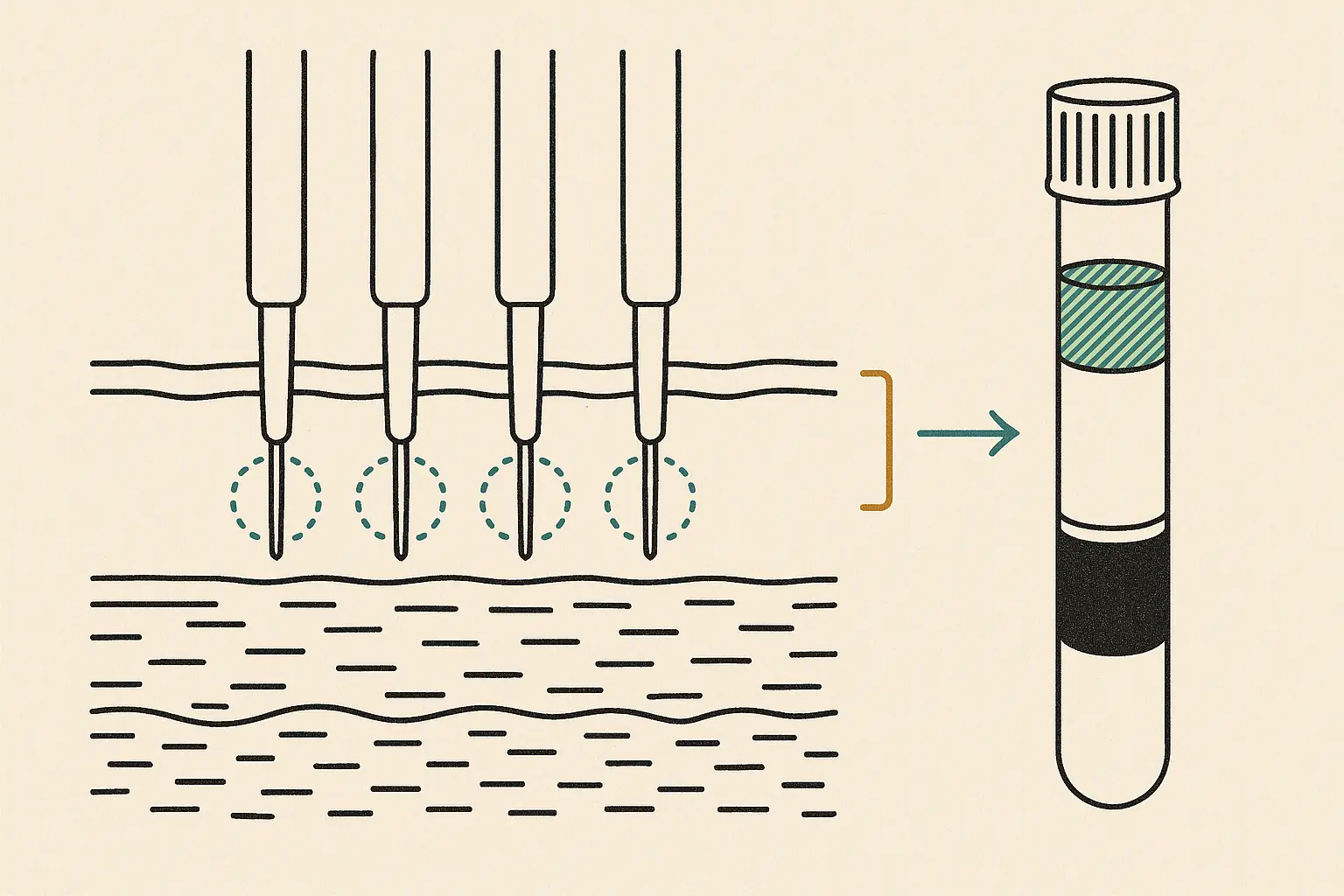
The verdict. Radiofrequency (RF) microneedling has real randomized-trial evidence for improving acne scars. MODERATE · RCT + case series Platelet-rich plasma (PRP) probably increases hair density in male- and female-pattern hair loss, based on pooled randomized trials, though the studies are inconsistent in how they prepare and deliver it. MODERATE · pooled RCTs Both treatments are highly operator-sensitive, and in October 2025 the FDA warned about serious harms from RF microneedling — burns, scarring, fat loss, and nerve damage — largely tied to misuse and inexperience. Neither treatment replaces a conversation with a licensed clinician, who is the only person who can judge whether either is right for you.
These two treatments often appear on the same spa menu and even in the same session, but they are different things doing different jobs, backed by different amounts of evidence. This page separates them: what each one is, what the trials actually measured, what the FDA does and does not say about them, and where the risks sit. Along the way it explains one phrase that does a lot of quiet work in aesthetic marketing — "FDA-cleared" — and why it is not the same as "FDA-approved." Everything below is informational only. Nobody associated with this publication received or performed either treatment; every number is attributed to the study that produced it.
What is RF microneedling, and how does it work?
Microneedling on its own uses fine needles to make controlled micro-injuries in the skin, prompting a wound-healing response that lays down new collagen. Radiofrequency microneedling adds a second mechanism: the needles also deliver radiofrequency energy — a form of electrical energy that generates heat — from their tips into the deeper layers of the skin. The devices are FDA-cleared and use either insulated or non-insulated microneedles to place that energy in the dermis and subdermis, where the localized thermal injury triggers collagen remodeling. Clinicians use these devices for skin rejuvenation, wrinkles, acne scarring, and skin tightening (Dermatology Times and Healio coverage of FDA device guidance; industry device safety notices) [1].
Two features of that description matter to a consumer. First, this is a heat-based, wound-based treatment: the result depends on injuring the skin in a controlled way, which means the settings — needle depth, energy level, number of passes — are the whole game. Second, because insulated needles shield the upper shaft, the energy is meant to spare the surface epidermis and concentrate deeper. When those settings are wrong, the injury lands in the wrong place, which is the thread running through the safety section below.
What does "FDA-cleared" mean — and why is it not "approved"?
RF microneedling devices are regulated as Class II medical devices that reach the market through the FDA's 510(k) clearance pathway [1]. That is a different, lower bar than the premarket approval (PMA) that a Class III device — such as a hyaluronic-acid dermal filler — must clear. MODERATE · FDA device pathways
Here is the distinction in plain terms, because marketing blurs it constantly. A 510(k) clearance means the manufacturer has shown the FDA that its device is "substantially equivalent" to a device already legally on the market — similar enough in purpose and technology. It does not require the manufacturer to prove in clinical trials that the device is effective for a given cosmetic result. A premarket approval, by contrast, requires evidence that the device is safe and effective for its intended use — a much heavier burden (FDA, "Premarket Notification 510(k)"; FDA device-marketing pathways) [11]. So a spa can accurately say a machine is "FDA-cleared" while that clearance says nothing about how well it will smooth your acne scars. "FDA-cleared," "medical-grade," and "clinically proven" are not interchangeable, and only the first has a fixed regulatory meaning. When a provider uses any of them, the useful follow-up is: cleared for what, and what evidence supports it for my concern?
How well does RF microneedling work for acne scars?
Acne scarring is where the RF-microneedling evidence is strongest, and it is genuinely encouraging. In a retrospective study of fractional RF microneedling for acne scars, 80.64% of patients improved by two grades on the Goodman–Baron scar scale (and 19.35% by one grade) [2]. A separate double-blinded, split-face randomized controlled trial of microneedle fractional radiofrequency found that treated skin improved 46.77% ± 21.33% in acne-scar scores from baseline [3]. A 2025 systematic review of fractional RF microneedling used on its own reports similar improvement in scar appearance across the published studies [4]. MODERATE · RCT + case series
Read those numbers honestly. That roughly 47% average reduction from baseline is a real, meaningful improvement in scars — not a cure, and with a wide spread (the ± 21.33% means results varied a lot between people). The 80.64% figure counts patients who improved by a set amount, which is a different metric than how much the average scar changed; both are useful, and neither promises the smooth skin in a marketing photo. And both come from small studies: the retrospective grading was in 31 patients, the split-face trial in roughly 30. This is why the verdict grades the acne-scar evidence "moderate" rather than "high": the trials are real but modest in size, and results depend heavily on the operator and the number of sessions.
What did the FDA warn about in 2025?
Most RF-microneedling side effects are minor and short-lived — redness, swelling, and bruising that settle in days [1]. But on October 15, 2025 the FDA issued a safety communication warning that serious complications have been reported with these devices: burns, scarring, fat loss, disfigurement, and nerve damage — some needing surgical repair or other medical intervention. The agency tied these harms largely to device misuse, operator inexperience, and overly aggressive settings, rather than to the technology being inherently unsafe; it stressed that RF microneedling is a medical procedure, not a simple cosmetic one, and should never be done at home (FDA safety communication, October 15, 2025, reported by Healio and Dermatology Times) [1].
That framing is the single most important thing on this page. The FDA is not saying RF microneedling cannot be done safely; it is saying the harm concentrates where an inexperienced hand meets an aggressive setting. The consumer takeaway is not fear — it is that who holds the device, and how conservatively they run it, matters more here than the brand name on the machine. Those variables turn directly into questions you can ask before anyone treats your skin, listed further down.
| Frequency | What can happen | Source |
|---|---|---|
| Common | Redness, swelling, and bruising that resolve over days | FDA device guidance / trade coverage [1] |
| Less common | Transient pigment change and prolonged redness, particularly at higher energy settings | FDA guidance [1] |
| Rare / serious | Burns, scarring, fat loss, disfigurement, and nerve damage — some needing surgical repair; linked to misuse, inexperience, and aggressive settings | FDA safety communication, Oct 2025 [1] |
After RF microneedling, get medical care if
Contact your treating clinician promptly, and seek in-person medical care, if in the days after a session you develop blistering or open burns, spreading pain, skin that turns pale or dusky, signs of infection (increasing redness, warmth, pus, fever), numbness or loss of movement in the treated area, or a visible depression or loss of fullness in the skin. Per the FDA's 2025 warning, burns, nerve damage, and fat loss are documented serious complications [1]. Adverse events from a medical device can be reported to the FDA's MedWatch program [12]. This box is information, not a diagnosis; a licensed clinician manages any complication.
What is PRP, and why is it "not FDA-approved"?
Platelet-rich plasma is made from your own blood. A clinician draws a sample, spins it in a centrifuge to concentrate the platelets, and re-injects that concentrate into the scalp or skin. The rationale is that platelets carry growth factors — signaling proteins with names like PDGF, VEGF, EGF, FGF, TGF-β, and IGF-1 — that are proposed to wake up hair-follicle stem cells, extend the growth (anagen) phase of the hair cycle, and support tissue repair (regenerative-medicine and PRP-in-hair-loss reviews) [9].
You will sometimes see PRP described as "not FDA-approved," said with alarm. Here is what that phrase actually means, stated plainly. Because PRP is derived from the patient's own blood, the FDA treats it as a biological product, and PRP as a treatment is not subject to the FDA pre-market approval process the way a drug is [9]. MODERATE · regenerative-medicine literature That is a description of the regulatory category, not a verdict on whether it works. It does mean there is no FDA label defining an approved use, dose, or preparation for cosmetic PRP — so the evidence has to come from the published trials, which is where we turn next.
What does the evidence show for PRP and hair loss?
The best-studied use of cosmetic PRP is androgenetic alopecia — the common pattern hair thinning that affects both men and women. A systematic review of 8 randomized controlled trials plus 1 cohort study, covering 291 participants, found that six studies reported significantly higher hair density with PRP versus control, and five reported significantly higher hair count [5]. A separate meta-analysis found a significantly higher hair density with PRP but no significant difference in hair diameter — that is, more hairs, but not necessarily thicker ones [6]. MODERATE · pooled RCTs
This is why the verdict says PRP "probably increases" hair density: the direction of the evidence is consistent and comes from randomized trials, which is real support — but the studies are heterogeneous, meaning they vary widely in how the PRP was prepared (spin speed, number of spins, platelet concentration), how much was injected, and how often. When protocols differ that much, it is hard to say precisely which recipe produced which result, and results in one clinic may not transfer to another. Promising and inconsistent are both true at once, and an honest summary holds them together.
Where does "PRP facial" marketing outrun the evidence?
PRP is marketed for two quite different purposes, and they do not carry the same evidence. The hair-loss data above are the strong part. The "PRP facial" — PRP applied to or injected into facial skin for a general glow or rejuvenation, sometimes paired with microneedling — is where marketing tends to outrun what has actually been measured. The trials cited on this page measured hair outcomes in androgenetic alopecia, not facial-skin rejuvenation [5][6]. So a claim that a PRP facial will smooth wrinkles or brighten skin is not supported by the hair-loss evidence, and this fact base does not carry trial data establishing that specific facial-rejuvenation benefit. NO RELIABLE EVIDENCE (here) · claims outrunning cited data That is not a claim it does nothing; it is a claim that the evidence being pointed to is about the scalp, and a careful reader should notice when a hair-loss result is being used to sell a facial.
What about combining the two — or adding minoxidil?
Because PRP and microneedling are both wound-and-repair treatments, they are often combined, and PRP is also paired with topical minoxidil (the over-the-counter hair-regrowth drug). Several studies report that PRP combined with microneedling or with topical minoxidil showed enhanced efficacy compared with a single treatment alone [7][8]. LOW · small combination studies Grade that gently: these are smaller studies, the combinations vary, and "enhanced efficacy" in a few trials is a weaker claim than the pooled hair-density result for PRP by itself. A combination that plausibly helps is worth discussing with a clinician; it is not a proven protocol you should insist on from a menu.
What does it cost?
Published cost figures for these treatments are looser than for injectables, because there is no single professional-society fee survey the way there is for botulinum toxin. For microneedling, a national cost summary drawing on aesthetic-society and industry data puts the average around $938, with a range of roughly $686 to $1,515 (CareCredit, citing national/ASPS-linked data) [10]. Read that the way you would any average: it is a reference point, not a quote, it does not separate plain microneedling from the radiofrequency version, and PRP — often priced per session on top — is usually extra. Local, all-in pricing varies widely. As always on this site, a price is a data point for your own budgeting, never a reason to choose the cheapest room; with heat-and-blood treatments, the operator's experience is the thing you are actually paying for.
Questions to ask a licensed clinician
The FDA's 2025 warning turns cleanly into a consultation. A good provider welcomes these questions; evasion is itself an answer. Print or screenshot this list and take it to the appointment. It pairs with our consultation checklist and the guidance on who is legally allowed to perform these procedures and how to verify a license.
- What is your license and credential, and who is the supervising or prescribing physician for this practice?
- For RF microneedling: which device, how many sessions do you expect, and what needle depth and energy settings will you use on my skin — and why those?
- How many of these procedures have you personally performed, and have you treated my skin type and concern before?
- Given the FDA's 2025 warning about burns, scarring, fat loss, and nerve damage, how do you set energy conservatively and check as you go? [1]
- For PRP: what is the evidence for my specific goal — is this for hair loss (where the trials are), or for facial rejuvenation (where they are not)? [5]
- How do you prepare the PRP, and how many sessions, over what timeline, before we would judge whether it is working?
- What are the warning signs of a serious problem, and who do I call — day or night — if I have blistering, spreading pain, numbness, or signs of infection?
- What is the itemized cost, including any repeat sessions, and what is included?
What we don't know
Reviewed to August 2026.
- The best PRP protocol. The hair-loss trials are consistent in direction but differ widely in preparation, dose, and schedule, so the evidence cannot yet say which protocol works best or how durable the gain is [5][6]. Hair count rose in the pooled data; hair diameter did not change significantly [6].
- PRP for facial skin. The trials cited here measured scalp-hair outcomes, not facial rejuvenation. The specific "PRP facial" glow claim is not established by this evidence base [5].
- Long-term RF-microneedling outcomes and the real-world harm rate. The acne-scar trials are short and modest in size [2][3], and the FDA's 2025 communication describes reported serious harms without a population-level rate [1] — so how often severe complications occur, and how well results hold up over years, remain open questions.
Not medical advice. This page is informational only and is not a substitute for a consultation with a licensed clinician. Candidacy, device settings, PRP preparation, and the management of any complication are individual medical decisions and are out of scope here.
References
- FDA Safety Communication, "Potential Risks with Certain Uses of Radiofrequency (RF) Microneedling" (dated October 15, 2025), reporting serious complications — burns, scarring, fat loss, disfigurement, and nerve damage, some needing surgical repair or medical intervention — tied to misuse, operator inexperience, and aggressive settings; device class (Class II, 510(k)) and mechanism. fda.gov (RF microneedling safety communication). Trade coverage: Healio Dermatology Q&A; Dermatology Times.
- Chandrashekar BS, et al. Evaluation of microneedling fractional radiofrequency device for treatment of acne scars (31 patients, skin types III–V; 80.64% improved by two grades and 19.35% by one grade on Goodman–Baron grading). J Cutan Aesthet Surg. 2014. PubMed 25136209.
- Split-face, double-blinded randomized controlled trial of microneedle fractional radiofrequency for facial atrophic acne scars (treated skin reduced 46.77% ± 21.33% in ECCA acne-scar scores from baseline). J Cosmet Dermatol. 2025. PMC PMC11838817.
- Fractional radiofrequency microneedling as a monotherapy in acne-scar management: a systematic review of current evidence. Clinical, Cosmetic and Investigational Dermatology. 2025. PubMed 39781098 · doi:10.2147/CCID.S502295.
- Systematic review of platelet-rich plasma for androgenetic alopecia (8 RCTs + 1 cohort, 291 participants; six studies significantly higher hair density, five significantly higher hair count). PubMed 38284294.
- Meta-analysis of PRP in androgenetic alopecia (significantly higher hair density; no significant difference in hair diameter). Aesthetic Plastic Surgery, doi:10.1007/s00266-023-03603-9.
- PRP combined with microneedling or topical minoxidil — enhanced efficacy in hair-loss studies. PMC PMC9670661.
- PRP with microneedling / topical therapy for androgenetic alopecia — combination outcomes. PMC PMC10924654.
- International Society of Hair Restoration Surgery (ISHRS) patient materials on platelet-rich plasma — PRP as an autologous blood product outside the FDA drug pre-market approval process; proposed growth-factor mechanism. ishrs.org.
- Microneedling cost summary (national average ~$938; range ~$686–$1,515), citing aesthetic-society/national data. CareCredit: carecredit.com; American Society of Plastic Surgeons: plasticsurgery.org.
- FDA, "Premarket Notification 510(k)" — substantial-equivalence clearance pathway, and how it differs from premarket approval (PMA). fda.gov/medical-devices/premarket-notification-510k.
- FDA MedWatch — the FDA Safety Information and Adverse Event Reporting Program, including medical-device adverse events. fda.gov/safety/medwatch.
Update log · Aug 2026 — first published.